
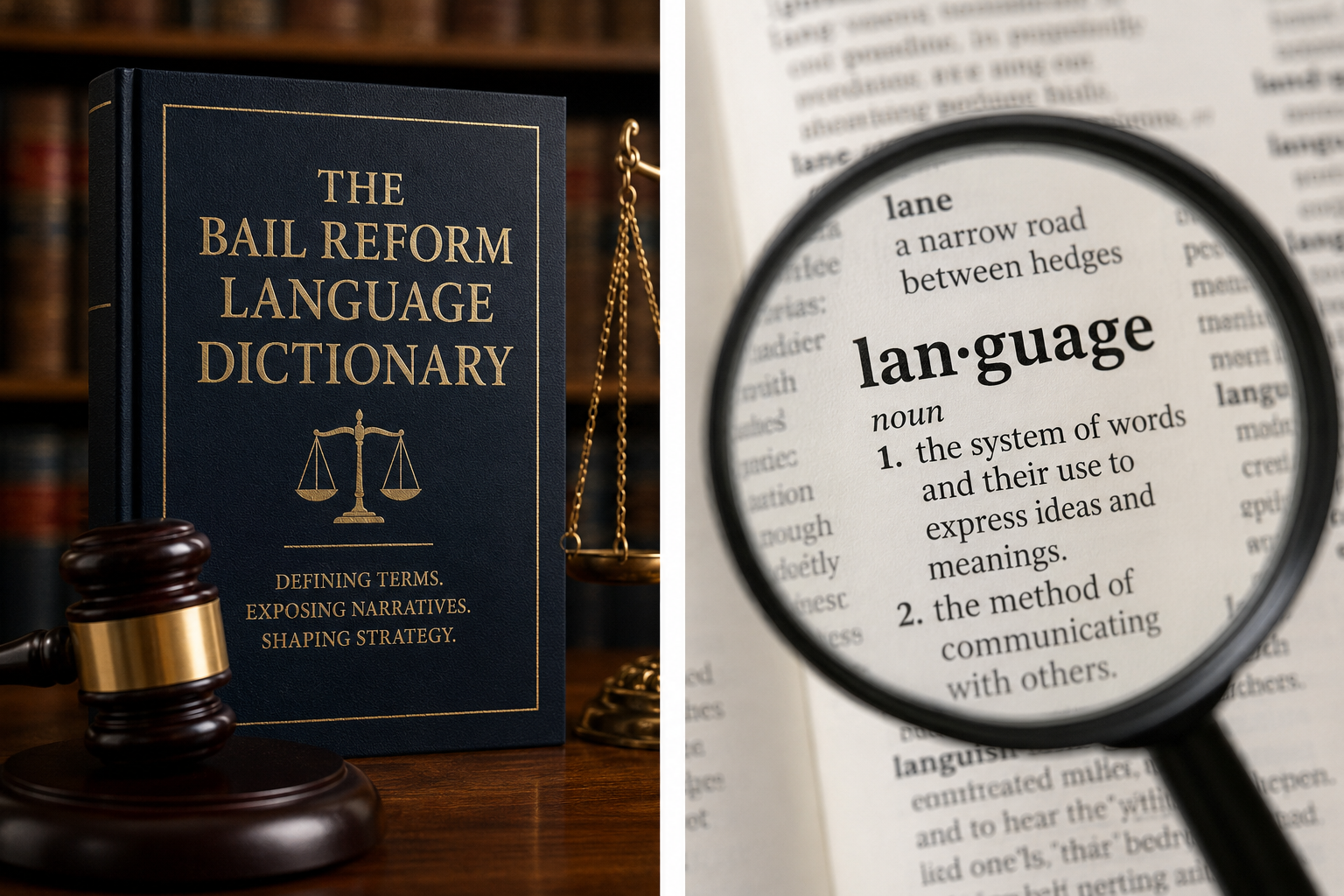
They Can't Win the Argument, So They're Changing the Dictionary
NABA Staff Writer · Policy Analysis
Friday, August 7, 2026
There is a strategy running through every piece of bail reform legislation, every court filing, every academic paper, and every advocacy campaign produced by the movement to eliminate the bail profession in America. It is not a legal strategy. It is not a public safety strategy. It is a language strategy.
Find a word that has worked against the profession for decades. Redefine it. Deploy the new definition in litigation. Get a court to adopt it. Use that ruling to change a statute. Use the statute to change the next court ruling. Repeat.
It has been happening for thirty years, and most people — including most people in the bail profession — have not recognized it as a single coordinated campaign. But the evidence is everywhere, hiding in footnotes, academic journals, court opinions, and the mission statements of organizations funded by the same foundation that built the risk assessment tool now being used to replace bail agents in courtrooms across the country.
Here is how the dictionary got rewritten — and what it cost.
Word One: "Bail"
The foundational move was redefining the word "bail" itself.
For most of American history, and in the common understanding of anyone who has ever watched a courtroom drama, "bail" means the money you post to get out of jail. You pay bail. You post bail. You make bail. The word is synonymous with the financial transaction.
The reform movement decided that was a problem. So they changed it.
Their argument, now embedded in court opinions and published in law reviews, goes like this: historically, "bail" didn't mean money at all. "Bail" meant the process of releasing someone before trial. Money was just one tool in that process — one that didn't even show up in a significant way until the late 1800s when commercial bail bondsmen first appeared. Before that, bail meant releasing someone into the custody of a responsible person who pledged to bring them back. The money came later. The release came first.
Therefore, "bail" simply means "release." Money is optional. A supervision condition is bail. An ankle monitor is bail. A check-in requirement is bail. Any mechanism that results in a person being released before trial is, by this definition, bail.
This argument was deployed in Illinois, where the Supreme Court ruled in Rowe v. Raoul (2023) that the Illinois Constitution's bail clause "does not include the term 'monetary,'" and that "monetary bail was all but unknown" when the constitution was drafted. The court cited a dictionary from that era defining bail as "the freeing or setting at liberty one arrested or imprisoned under security taken for his appearance" — with no mention of money.
Advancing Pretrial Policy and Research — APPR, the organization that manages and promotes the Arnold Ventures-funded Public Safety Assessment tool — published a piece in Law360 celebrating the ruling under the headline "The Meaning of 'Bail' Has Strayed Far From Its Legal Roots." Their argument was explicit: "bail" was never supposed to mean money. Commercial bail bondsmen distorted the word. The reform movement is simply restoring the original meaning.
That is not legal analysis. That is a branding campaign with footnotes.
The practical result: once "bail" means "release by any mechanism," the constitutional right to bail no longer requires access to a bail agent or a surety bond. It requires only that some pathway to release exist — including a pretrial supervision officer, a government check-in program, or an ankle monitor paid for by taxpayers. The commercial bail profession has been written out of the constitutional text without a single amendment being passed.
Word Two: "Surety"
The same operation was run on "sufficient sureties" — the phrase that appears in bail clauses of most state constitutions, including California's. That phrase has guaranteed the right to pretrial release in America since before the nation was founded.
The reform movement's historical revisionism on this word was so useful that the California Supreme Court cited it directly in the Kowalczyk opinion handed down in April 2026. Footnote 22 of that opinion quotes a 2024 Harvard Law Review article — Funk & Mayson, Bail at the Founding — for the following proposition:
"A surety was an individual — typically a family member, friend, or employer — who also pledged to forfeit a specified sum if the defendant failed to appear. The pledges by the defendant and his sureties were promises only; they were not themselves secured by any transfer or collateral or legal right."
The implication is clear, and intentional: if the Founders meant "surety" to refer to a person who made a personal pledge, not a licensed insurance company writing a bond backed by capital reserves, then a pretrial supervision officer — a government employee who pledges to supervise a defendant — might qualify as a "surety" under the constitutional text.
A government supervision program. Funded by taxpayers. Run by an agency funded by Arnold Ventures. Could be a "surety."
The bail profession, with its centuries of common law history as the paradigmatic surety relationship, has been reduced to a historical curiosity — one way of providing a "surety," but not the only way, and not the constitutionally required way.
APPR made the same argument from the other direction: "At this time, 'sureties' were typically people responsible for the accused person's appearance in court." Personal sureties. Not commercial ones. The commercial bail bondsman, they argue, is a late-arriving distortion of the original concept — one that can now be discarded in favor of government supervision, which they position as a return to the founding tradition.
The bail profession has been in the surety business for over a century. The reform movement just declared that the original sureties were government employees.
Word Three: "Money Bail"
Watch how the vocabulary shifts depending on who is speaking.
When a bail agent writes a bond, the reform movement calls it "money bail." Not a surety bond. Not a bail bond. Money bail. The term is precise and deliberate — it reduces the transaction to its most mercenary-sounding element, strips out the accountability mechanism, the enforcement authority, the indemnitor relationship, the surety company liability, and the bail agent's legal obligation, and leaves only the money.
"Money bail" sounds like paying a ransom. It sounds like buying your way out of accountability. It sounds like a wealth-based system where rich people go free and poor people stay in jail.
"Surety bond" sounds like an insurance product backed by regulated companies, underwritten by licensed agents, enforced by private professionals with legal authority and financial skin in the game.
Same transaction. Completely different moral picture. The reform movement chose "money bail" and never looked back.
APPR explicitly teaches media outlets to use "money bail" instead of "bail bond" or "surety bond." Their media guide defines cash bail, lists "money bail" and "secured bond" as synonyms, and frames all of it as a mechanism of detention rather than a mechanism of release. The word "surety" — the actual legal and constitutional term — appears as a synonym buried in a list, stripped of its historical and legal significance.
When you control what a thing is called, you control how people feel about it. The reform movement understood this earlier and better than the bail profession did.
Word Four: "Pretrial Advancement"
This one is subtle but revealing.
The organization APPR — Advancing Pretrial Policy and Research — explicitly states on its website that it uses the phrases "pretrial advancement" or "pretrial improvement" rather than "bail reform."
Why? Their own explanation: "improving pretrial systems requires more than a single fix, like eliminating monetary bonds. Sustained and measurable improvement requires a comprehensive approach."
Translation: "bail reform" sounds like a specific thing you can evaluate and argue about. "Pretrial advancement" sounds like a direction — an improvement, a progression, a forward movement. You cannot be against advancement. You cannot be against improvement. The debate has been reframed before it begins.
Calling it "bail reform" invites the question: reform toward what? Better outcomes? For whom? Compared to what baseline? Those are questions the reform movement does not want to answer, because the data on what happened in New Jersey, Illinois, and New York after their reforms does not support the narrative they have built.
Calling it "pretrial advancement" forecloses those questions. It is advancement. It moves forward. Anyone who opposes it is opposing progress.
Word Five: "The Industry"
The reform movement never refers to bail agents, bail bondsmen, or bail professionals. They refer to "the bail bond industry" or "the commercial bail industry" or, in their more pointed moments, "for-profit bail."
"Industry" is a word that calls up images of corporations, lobbyists, and profit motives. An industry has interests. An industry extracts money. An industry is not a profession — it does not have ethics, standards, or a calling. Industries do not serve communities. They serve shareholders.
APPR's Law360 piece refers to "the bail bond industry's $2.4 billion in annual profits" — a figure specifically chosen to make licensed bail agents sound like a revenue extraction mechanism rather than a service profession. The same article does not mention the industry's $0 cost to taxpayers. It does not mention the industry's self-funded enforcement mechanism that returns fugitives to court at no expense to law enforcement. It does not mention that those "profits" represent the cost of assuming billions of dollars of legal liability on behalf of defendants who might otherwise sit in jail.
When the reform movement calls bail agents an "industry," they are not describing what bail agents do. They are describing how bail agents should make the public feel.
The Illinois Proof of Concept
The Arlington Cardinal article from July 2026 that prompted this discussion contains a small detail that crystallizes the entire language strategy.
Illinois eliminated cash bail under the SAFE-T Act's Pretrial Fairness Act, effective September 18, 2023. Commercial bail bondsmen are gone. The surety bond system has been abolished. And yet — Illinois Compiled Statutes 720 ILCS 5/32-10 still defines the crime of breaking release conditions as "Violation of Bail Bond."
Police departments still use the phrase. Courts still use it. News outlets covering arrests still use it. A man wanted for "Violation of Bail Bond" was arrested at a Burger King in Arlington Heights in July 2026 — in a state where bail bonds do not legally exist.
The framework the bail profession built — the legal infrastructure of the bond, the obligation, the violation — is so foundational to the criminal justice system that even after the bail profession was legislated out of existence, the system could not stop using bail profession terminology to describe what it was doing.
That is not an accident or an oversight. It is proof that the bail system is not a product. It is infrastructure. And when you remove the infrastructure but keep using the vocabulary, you reveal what you actually lost.
Illinois eliminated the bail agent. It kept the bail bond violation. It kept the conditions. It kept the obligations. It kept the framework. It just removed the one party who had real money on the line, real authority to act, and a real personal interest in making sure defendants came back to court.
The Playbook, Stated Plainly
Here is what the bail reform movement's language strategy amounts to when you lay it out in sequence:
- Redefine "bail" as "release by any mechanism" so that the constitutional right to bail no longer requires access to a surety bond.
- Redefine "surety" as "any person who pledges to be responsible for a defendant" so that a government supervision officer can satisfy the constitutional requirement.
- Rename the commercial bail transaction "money bail" to strip it of its legal and professional character and reduce it to a wealth-based detention mechanism.
- Rename the reform campaign "pretrial advancement" to make opposition grammatically incoherent.
- Rename bail agents an "industry" to disqualify their professional standing and reframe their accountability function as profit extraction.
- Get courts to adopt the new vocabulary. Once a court has held that "bail" means "release" and "surety" means "any responsible person," the constitutional text that protects the bail profession has been neutralized — without a single constitutional amendment.
- Use that judicial validation to drive legislation that eliminates commercial bail. Point to the legislation to validate the next round of judicial advocacy.
The Kowalczyk footnote citing a Harvard Law Review article arguing that founding-era sureties were people, not companies, is Step Six in action. The Illinois SAFE-T Act was Step Seven. California's SB 562 mandating premium refunds is the financial pressure of Step Seven extended.
What the Bail Profession Should Be Saying
The response to a language campaign is not silence. It is a counter-language campaign grounded in accuracy.
"Bail" is not just release. Bail is the constitutional mechanism that guarantees pretrial liberty through private accountability. A defendant released to a pretrial supervision officer has been released. A defendant released on a surety bond has been bailed. Those are not the same thing, and the difference is not semantic — it is the difference between a government promise and a private obligation backed by financial liability and enforcement authority.
"Surety" is not any responsible person. A surety is a licensed party who has posted capital, signed a legal obligation, assumed financial liability, and accepted enforcement responsibility. A pretrial services officer who checks in with a defendant twice a week is not a surety. They are a government employee with a caseload and no financial consequences if their client disappears.
"Bail bond" is not "money bail." A bail bond is an insurance product, backed by a regulated surety company, written by a licensed agent, secured by an indemnitor agreement, and enforced by a private professional with legal authority. Calling it "money bail" is like calling a mortgage "debt slavery."
"Bail reform" is not "pretrial advancement." Reform implies improvement. When failure-to-appear rates increase, when defendants on pretrial supervision reoffend, when bench warrants pile up faster than law enforcement can serve them, that is not advancement. That is documented, measurable regression — and the data from New Jersey, Illinois, and New York is available for anyone willing to read it without the reform movement's editorial framing.
And bail agents are not an "industry." They are a profession — licensed, regulated, bonded, and legally obligated to the courts they serve. They are the only pretrial release mechanism in the American justice system that costs taxpayers nothing, holds a private party legally accountable for a defendant's appearance, and has an enforcement mechanism that functions 24 hours a day, 365 days a year, with no government appropriation required.
The Bottom Line
When you cannot win the argument on the merits, you change the argument by changing the words. The bail reform movement has been doing this for thirty years, and they have been doing it with extraordinary sophistication, coordination, and funding.
They did not eliminate bail in Illinois by passing a bill that said "we are eliminating the accountability mechanism of the surety bond system." They passed a bill called the Pretrial Fairness Act. They did not argue that a government supervision officer should replace a bail agent. They argued that the original "sureties" were personal guarantors, not commercial companies, and that pretrial supervision is a return to founding principles.
They did not attack the bail profession directly. They redefined it out of existence.
The bail profession's most important advocacy task right now is not a single bill, a single court case, or a single election. It is reclaiming the language. Every bail agent, every state association, every brief, every testimony, every article should use the precise terms — surety bond, bail agent, bail professional, pretrial accountability — and should refuse to adopt the reform movement's vocabulary.
Words build courtrooms. The bail profession built the vocabulary of pretrial accountability. It is past time to take it back.
Related articles

Impersonating a Fugitive Recovery Agent Is More Than Misleading—It Endangers the Public
Aug 7, 2026

California Is About to Give Prosecutors a Reason to Let Defendants Walk Free — And Bill the Bail Agent for It
Aug 6, 2026

The Fix Is In: How a California Court Ruling Is Being Used to Dismantle the Bail System — And What Utah's Experience Tells Us About What Comes Next
Aug 6, 2026