

California Is About to Give Prosecutors a Reason to Let Defendants Walk Free — And Bill the Bail Agent for It
NABA Staff Writer · Policy Analysis
Thursday, August 6, 2026
There is a provision buried inside California's Senate Bill 562 that nobody is talking about. Not the fiscal analysts. Not the bail agents testifying in opposition. Not the journalists covering the bill.
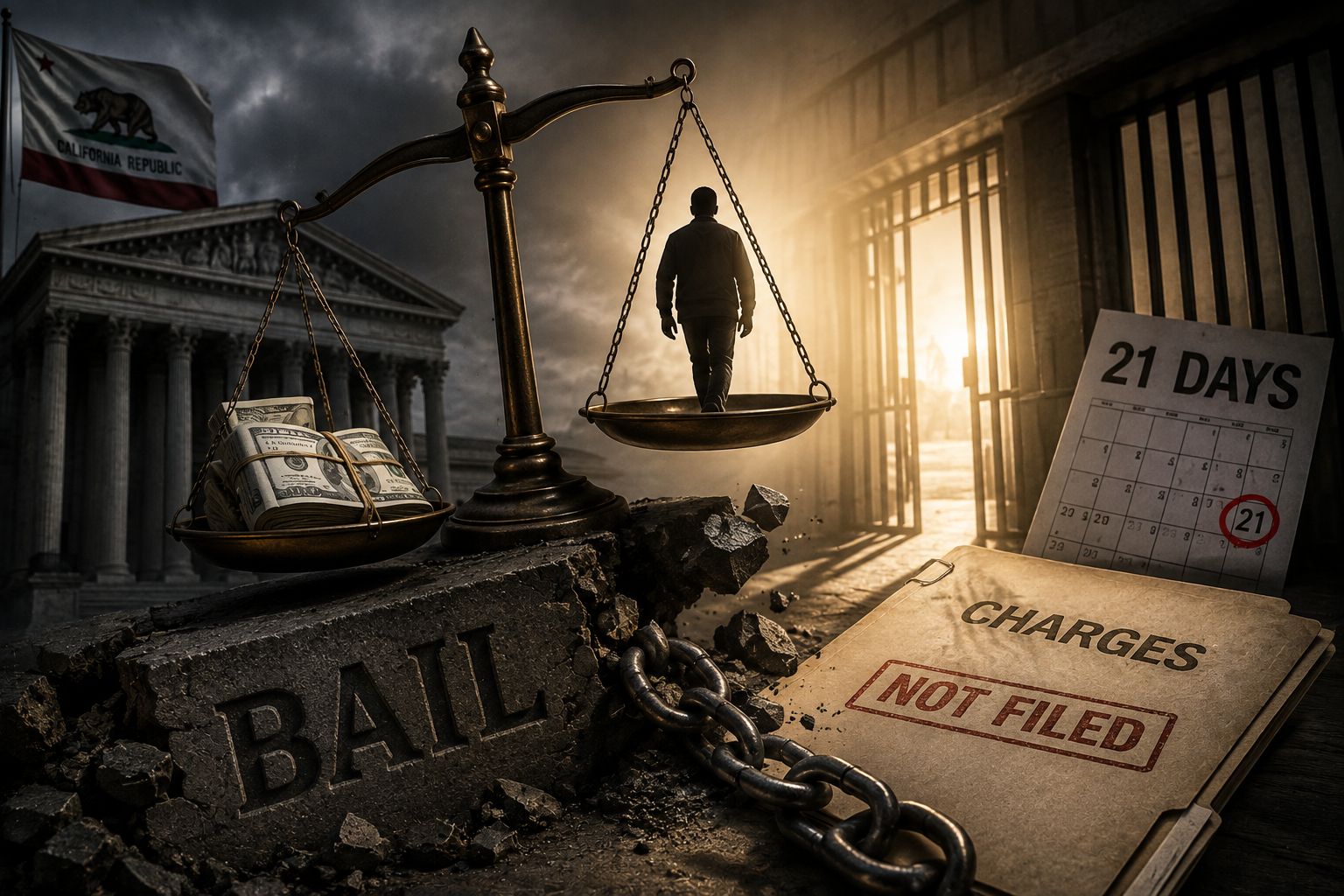
Here it is: if a prosecutor fails to file charges within 21 days of a defendant posting bail, the bail agent would be legally required to refund almost the entire premium.
Read that again slowly.
If the prosecutor doesn't do their job on time, the bail agent pays for it.
Now ask yourself: in a state where bail reform advocates have spent a decade trying to move defendants off of surety bonds and onto government supervised release — what happens when a DA who shares that ideological goal quietly lets the 21-day clock run out?
The defendant walks out with no financial accountability. The pretrial services agency picks up another supervised case. The bail agent writes a refund check. And nobody in Sacramento has to answer for any of it.
That is not a hypothetical. That is an incentive structure written directly into the bill. And it is the most dangerous thing about SB 562 that nobody has put in print yet.
What the Bill Actually Does
California SB 562, authored by Senate Majority Leader Angelique Ashby, proposes to add a new section to the Penal Code that would require courts to order a premium refund to any defendant whose bail agent posted bond if:
- The prosecutor dismisses charges within 21 days of arraignment, or
- The prosecutor fails to file charges within 21 days of the bond being posted and the defendant didn't miss any required appearances
Under the bill, the bail agent would get to keep an "administrative reimbursement" of 2% of the bond face amount plus whatever premium tax they already paid to the state. Everything else goes back to the defendant.
On a $10,000 bond — a completely ordinary number in California — the bail agent who charged a $1,000 premium would keep $200, before their own costs. The surety company already collected its fees. The state already got its tax. The credit card processor already took its cut. The bail agent — the one person who put real money on the line and assumed legal liability the moment the defendant walked out of jail — gets what's left over after everyone else is paid.
Two hundred dollars. On a bond they may have written at midnight, after a background check, an indemnitor interview, and a signed power of attorney that put thousands of dollars of their surety's money at risk.
That is the bill the Senate Majority Leader of California is currently advancing through the Assembly Appropriations Committee.
Nobody Is Buying Insurance for a Fire That Already Happened
Every other industry in the United States understands a basic principle: you pay for risk coverage while the risk is active, not after you find out nothing went wrong.
You pay your car insurance premium every month. At the end of the year, if you never had an accident, your insurance company does not send you a refund. Why? Because they were on the hook every single time you turned the ignition. The risk was real. The coverage was provided. The premium was earned.
You pay homeowner's insurance on a house that never burns down. Your insurer is not writing you a check in December because your kitchen stayed intact. The policy had value — it just didn't get used. Those are two different things.
A bail premium works exactly the same way. The moment a bail agent signs a power of attorney and a defendant steps through the jail door, the financial risk is live. That defendant could fail to appear tomorrow. They could flee the state tonight. They could be picked up on a new charge in a week. None of those outcomes can be predicted at the time of posting, and all of them cost the bail agent real money if they happen.
The fact that a district attorney later decides not to file charges — for reasons that have nothing to do with the bail agent, the bond, or anything the bail agent could have known or controlled — does not retroactively eliminate the risk that was assumed. The service was provided. The risk was real. The coverage was live.
SB 562 says none of that matters. If the DA doesn't file in 21 days, the premium was apparently for nothing.
By that logic, every insurance policyholder in America who didn't file a claim this year is owed a refund.
The Prosecutor Problem Nobody Will Say Out Loud
Here is where SB 562 gets genuinely dangerous, and where every other analysis of this bill has stopped short.
If passed, SB 562 would create a direct financial incentive for prosecutorial inaction.
California's bail reform movement has been trying for years to move defendants off surety bonds and into government supervised release programs. That goal is held by many elected DA's, particularly in the state's urban counties. Most of them cannot achieve it through legislation alone — because California still has a right to bail, and defendants still have the option of posting a surety bond.
But SB 562 would create a new tool. If a DA's office wants a defendant released without the accountability of a bail bond — released to pretrial supervision, released on their own recognizance, released in any fashion that doesn't involve a bail agent holding financial liability — all they would have to do is wait.
Don't file charges in 21 days. Let the clock expire. The bail agent is forced to refund the premium. The bond is exonerated. The defendant walks out with whatever conditions the court imposes — which, in California's current climate, may be very few.
The bail agent eats the loss. The pretrial services agency gains a client. The DA's office achieves through administrative delay what it could not achieve through legislation.
And the defendant — the actual human being at the center of this — is left without the one form of pretrial accountability that has a real financial consequence if they disappear.
Nobody in Sacramento will admit this is the design. But the incentive is written directly into the bill's text, and it would be available to every politically aligned prosecutor in the state the moment it takes effect.
The Bill Punishes the Only Party Who Had Nothing to Do With Any of This
Let's be precise about who is responsible for what in the chain of events that SB 562 is supposedly correcting.
A police officer makes an arrest based on probable cause. The bail agent had nothing to do with that decision.
A magistrate sets a bail amount. The bail agent had nothing to do with that decision.
A defendant or their family contacts a bail agent and asks for help posting bond. The bail agent steps in here — for the first and only time — and provides one service: they put their money on the line to get that person out of jail.
The prosecutor then decides whether to file charges, when to file charges, and what charges to file. The bail agent has nothing to do with any of that.
If the prosecutor doesn't file within 21 days — because the case is weak, because they're backlogged, because a witness is uncooperative, because they simply deprioritized it, or because they strategically chose to let the clock run — SB 562 would require the bail agent to refund the defendant's premium.
Not the prosecutor. Not the arresting officer. Not the court. Not the county that collected booking fees. Not the defense attorney who took a retainer. Not the tow company that impounded the vehicle.
Just the bail agent.
The one party in the entire criminal justice chain who had zero involvement in the charging decision, zero control over the timeline, and zero ability to affect the outcome would be the one party required to write the check when that timeline isn't met.
That is not consumer protection. That is scapegoating with a bill number attached.
What This Does to the Defendant Who Actually Needs Help
Supporters of SB 562 frame it as protection for defendants who are arrested but never charged. The sympathy framing is effective. Who wants to defend keeping money from someone who turned out to be innocent?
But the actual effect of this bill on actual defendants — the low-income defendant, the defendant who needs help getting out of jail at 2am — is the opposite of protective.
Bail agents are small businesses. They operate on thin margins. They carry surety company fees, licensing costs, insurance, and overhead before they see a dollar of profit on any bond they write. They also operate in an environment where they cannot always know, at the time of posting, whether the DA is going to file charges quickly, slowly, or not at all.
If SB 562 passes, every bond written on a case with an uncertain charging timeline becomes a financial gamble. Write the bond tonight and risk a forced refund in three weeks, or wait until the DA actually files and let the defendant sit in jail in the meantime.
Most bail agents would wait. The rational business decision is obvious. The defendant — the one sitting in a jail cell with a job to get back to, children to get home to, a life being disrupted by every additional night of detention — is the one who suffers for it. They sit longer. They may lose their job. They may accept an unfavorable plea deal just to get out.
SB 562 would not protect the defendant who gets arrested on a weak case. It would guarantee that defendant stays in jail longer while everyone waits to see what the DA does. That is the direct, predictable, unavoidable consequence of the financial incentive this bill would create.
Freedom delayed is freedom denied. If SB 562 passes, it guarantees more of both.
The Domestic Violence Trap
There is one specific category of case where SB 562 produces an outcome so backward it almost defies belief: domestic violence.
California law enforcement responds to roughly 160,000 domestic violence incidents per year. A large percentage of those arrests result in charges that are dismissed or never filed — not because the arrest lacked probable cause, not because the defendant was innocent, but because the victim recanted. This is one of the most well-documented patterns in criminal justice. Victims of domestic violence are frequently pressured, manipulated, or financially coerced into withdrawing their cooperation with prosecutors. When that happens, the case often cannot proceed.
Under SB 562, when it happens within 21 days: mandatory refund.
The bail agent who got a domestic violence defendant out of jail — the bail agent who had no role in the arrest, no role in the charging decision, and no ability to control what happened between the defendant and the victim after release — would owe that defendant most of their premium back because the victim was too afraid to testify.
The system worked exactly as it was supposed to. A dangerous person was arrested on probable cause. A professional underwrote their release. The case fell apart for reasons entirely outside the bail system.
SB 562 says: bail agent pays anyway.
The Courts Get Buried and Nobody Budgeted for It
The bill carries a legislative designation of "Fiscal Committee: NO" and "Local Program: NO" — the Legislature's official certification that SB 562 has no significant fiscal impact on local government.
That certification is wrong — and if the bill passes, California's courts will find out the hard way.
SB 562 would create an entirely new category of court proceeding that does not currently exist anywhere in California law. A defendant files an application for a premium refund. The court reviews the 21-day timeline. The court verifies whether charges were filed. The court confirms whether the defendant made all required appearances. The court issues a formal order. The bail agent disputes the calculation or the timeline. A hearing is scheduled. A judge presides. A clerk processes. A bailiff attends. A reporter transcribes. The DA's office appears to verify its own filing record. The bail agent or their attorney responds. The court manages disputed funds if the surety contests the order.
Multiply that process across every refund-eligible case, every year, across California's 58 counties. The Legislature's official estimate of $1.5 million to $5 million annually is almost certainly wrong by an order of magnitude. Independent analysis puts the real statewide cost at $30 million to $70 million per year once the full administrative chain is accounted for.
Not a dollar has been appropriated. Not a position has been funded. Not a software update has been budgeted. Every court clerk who would become a refund compliance processor, every judge who would spend forty-five minutes on a premium dispute, every DA paralegal who would dig through filing records to verify a timeline — all of it would come out of budgets that are already running on fumes.
The California Constitution requires the state to reimburse local governments when it mandates new programs or higher service levels. SB 562 would mandate a new program and provide zero reimbursement. That is an unconstitutional unfunded mandate wearing the disguise of a consumer protection bill — and if it passes, the litigation from county governments will begin almost immediately.
Who Is Pushing This — And Why
Senator Angelique Ashby is the author of SB 562. As of December 2025, she is also the Senate Majority Leader — the second most powerful position in the California Senate. This bill has institutional muscle behind it.
When SB 562 came before the Assembly Public Safety Committee, one of the organizations that showed up to testify in support was The Bail Project — a national nonprofit that provides free bail to defendants at no charge, is funded by the same network of foundations that has spent hundreds of millions of dollars working to dismantle the commercial bail profession, and has an obvious institutional interest in making the economics of commercial bail as unstable as possible.
SB 562 is not the first piece of California legislation aimed at the bail profession. It will not be the last. The original version of this very bill was far more aggressive — it required refunds whenever charges were dismissed or bond conditions were modified, period, with no 21-day limit. That version was too obvious. It got narrowed in committee.
What remains is a bill whose 21-day window and 2% retention cap are precisely calibrated to accomplish the same goal through a slower mechanism: make bail agent economics unsustainable on an expanding category of cases. This session it's 21 days on cases with no charges. Next session the window expands. The session after that the trigger conditions multiply. Each individual step sounds reasonable. The cumulative direction is not.
The Bottom Line
California SB 562 is built on a false premise — that a bail premium is payment for a conviction rather than payment for the assumption of risk. If it becomes law, it would punish bail agents for decisions made entirely by prosecutors they have no control over. It would create a financial incentive for ideologically aligned DAs to run out the clock on charging decisions. It would make bail harder to get for the very defendants it claims to protect. It would impose an unconstitutional unfunded mandate on courts across 58 counties. And it would hand domestic violence defendants a mandatory refund trigger activated by the most predictable dynamic in DV prosecution — a victim too afraid to testify.
As of August 2026, SB 562 is before the Assembly Appropriations Committee. It is alive. It has the Senate Majority Leader's name on it and the full weight of California's bail reform movement behind it. The Assembly Appropriations Committee does not hold public testimony — the next stop after a committee vote is the Assembly floor, and then the Governor's desk.
There is still time to stop it. But the window is closing fast. And the framework it would establish — mandatory premium refunds tied to prosecutorial timelines — is already being watched by bail reform advocates in every other state in the country, ready to be replicated the moment California signs it into law.
Every state in the country should be watching what happens next in Sacramento. Because what starts in California never stays there.
Further reading: Susan Shapiro's companion analysis, "The Unspoken Price Tag: Why SB 562's Fiscal Impact Is a Public Ledger Nightmare," breaks down the court-by-court administrative burden the bill would create.
Related articles
They Can't Win the Argument, So They're Changing the Dictionary
Aug 7, 2026
Impersonating a Fugitive Recovery Agent Is More Than Misleading—It Endangers the Public
Aug 7, 2026
The Fix Is In: How a California Court Ruling Is Being Used to Dismantle the Bail System — And What Utah's Experience Tells Us About What Comes Next
Aug 6, 2026