
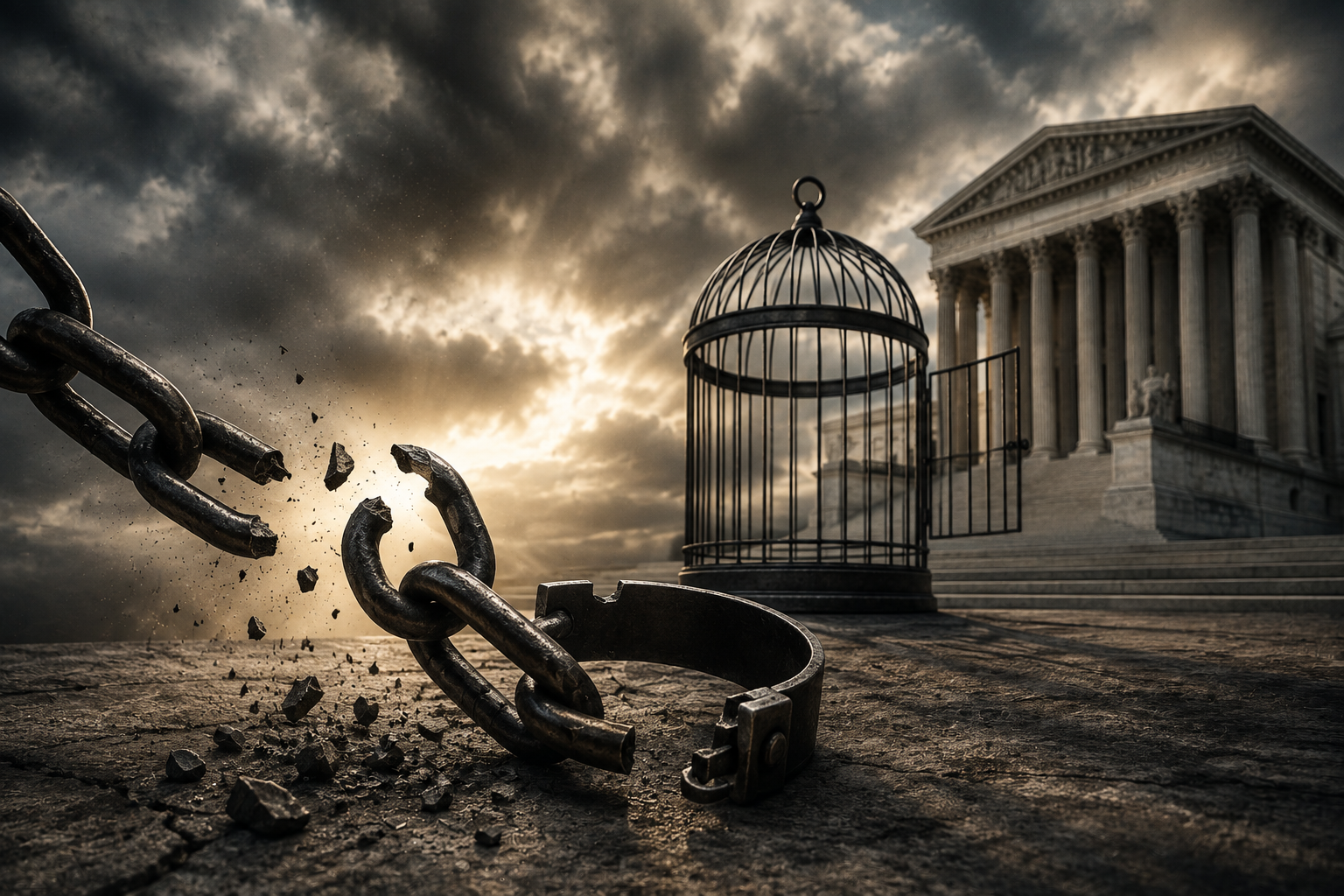
The Fix Is In: How a California Court Ruling Is Being Used to Dismantle the Bail System — And What Utah's Experience Tells Us About What Comes Next
NABA Staff Writer · Policy Analysis
Thursday, August 6, 2026
Imagine you're a judge. A defendant stands before you. You have twenty minutes to decide whether to release this person into the community or hold them in jail until trial. A form lands on your bench. It says the defendant earns very little money, has no assets, and cannot afford meaningful bail. A pretrial services officer — a government employee funded by an out-of-state foundation with an explicit anti-bail agenda — has already interviewed the defendant and is recommending release under their supervision instead of a surety bond.
You set a low bail. The defendant walks out that afternoon. No bond is posted. No bail agent is accountable if that person disappears. No licensed professional has any legal or financial obligation to ensure that defendant ever sees the inside of a courtroom again.
Now here is the part they leave out of the press release: that defendant was coached — before they ever stood in front of you — on exactly what to say to make sure a bail bond never entered the picture.
This is not speculation. It is happening right now. And a California Supreme Court ruling handed down on April 30, 2026 has just written that playbook into constitutional law.
What the California Court Decided
The case is In re Kowalczyk, decided unanimously by the California Supreme Court. The defendant, Gerald Kowalczyk, was arrested after using stolen credit cards to attempt the purchase of a hamburger. He had 64 prior convictions. The trial court denied bail and ordered him detained. His lawyers argued that was unconstitutional. The Supreme Court agreed — and used the case to lay down two new rules for the entire state.
Rule One: Courts can only deny bail outright in a narrow set of cases — violent felonies, felony sexual assault, or credible threats of great bodily harm. For everyone else, bail must be available. A repeat offender charged with fraud, theft, drug crimes, or any nonviolent felony generally cannot be held without a bail option.
Rule Two: If a court sets bail, it must be in an amount the defendant can actually post. Courts cannot set bail so high that a defendant has no realistic chance of paying it. That, the Court said, is unconstitutional detention disguised as a bail order.
On paper, those sound like constitutional principles worth debating. In practice, they are a wrecking ball aimed at the surety bail system — because the organizations waiting to exploit this ruling have spent years preparing for exactly this moment.
Who Is Behind This, and What Do They Actually Want
Before going further, it is important to understand who is driving bail reform nationally, because the California ruling did not emerge from a vacuum.
The primary engine behind the elimination of secured bail in the United States is Arnold Ventures — formerly the Laura and John Arnold Foundation — a private foundation based in Houston, Texas. Arnold Ventures has spent hundreds of millions of dollars over the past decade funding a coordinated national campaign to replace the surety bail system with government-supervised pretrial release programs.
Their strategy has three interlocking components, and understanding all three is essential to understanding what is happening in courtrooms right now.
First, they fund the advocacy. Arnold Ventures has bankrolled legislative campaigns, academic research, media organizations, and advocacy groups in state after state, pushing the narrative that cash bail is unfair and that pretrial supervision produces equivalent outcomes. That research is produced by organizations they fund, published in outlets they support, and cited by legislators they have cultivated. It is a closed information loop.
Second, they fund the infrastructure. Arnold Ventures provides direct grant funding to pretrial services agencies across the country — the government and nonprofit organizations that conduct defendant interviews, generate release recommendations, and supervise defendants after release. These agencies have an institutional interest in maximizing the number of defendants who flow through their supervision pipeline. Every defendant released on a surety bond is a defendant who did not generate a supervised case for their program, did not justify a line item in their budget, and did not support their next grant renewal application.
Third — and this is where the conflict of interest becomes impossible to ignore — Arnold Ventures also created the Public Safety Assessment, the algorithmic risk-scoring tool that most of these pretrial services agencies now use to generate the release recommendations that land on judges' desks. The same foundation that funds the agencies also built the tool the agencies use. They have placed themselves at every critical decision point in the pretrial release process, and they have used that position to systematically route defendants away from surety bonds and into their supervised release pipeline.
The surety bail profession — the only actor in the entire pretrial release system that is self-funding, requires no taxpayer dollars, and holds a licensed private party legally and financially responsible for a defendant's court appearance — has been methodically cut out of the process. That is not an accident. It is the goal.
The Coaching Problem: How It Actually Works
The Kowalczyk ruling requires courts to conduct an individualized ability-to-pay assessment before setting bail. That sounds procedurally reasonable. The problem is who controls the information that feeds that assessment — and what happens before the defendant ever walks into the courtroom.
Before arraignment, a pretrial services officer visits the defendant in jail. They conduct an intake interview. They ask about income, employment, assets, family, housing, and financial resources. The answers go into a report. The report goes to the judge. The judge uses it to determine what bail to set.
Now consider the incentive structure of that interview. The pretrial services officer works for an agency that exists to place defendants into supervised release programs. Their budget depends on supervised caseload. Their grant renewal depends on demonstrating program volume. They know, from experience, what answers produce a release-to-supervision recommendation versus a bail order. And they are conducting this interview alone, in a jail cell, before the defendant has an attorney, with no recording requirement and no prosecution present.
The defendant does not need to be told to lie. They do not need explicit instructions. They need only to understand — through the framing of the questions, through the officer's reactions, through the informal guidance that flows naturally in that setting — that certain answers lead to going home quickly, and other answers lead to a bail amount that keeps them in jail. The rational defendant, in that situation, provides the answers that get them out.
What they are not told is what they are giving up. A surety bond means a bail agent is legally and financially on the hook for their return to court. It means someone with enforcement authority and a direct financial incentive will make certain they appear at every hearing. It means the accountability structure of the justice system remains intact. Pretrial supervision offers none of that. It offers check-ins, monitoring fees, and a bench warrant if things go wrong.
The defendant is coached — subtly or explicitly — to choose the option that serves the pretrial services agency's interests, not their own long-term interest in navigating the justice system successfully, and certainly not the community's interest in knowing that someone is genuinely accountable for that defendant's appearances.
Utah Proved This Happens. The Record Is in Their Own Documents.
California is not the first state to travel this road. Utah got there first, and what happened there is documented in official government records — not allegations from the bail profession, but the official meeting minutes of Utah's own court committees.
In 2020, Utah passed HB 206, a bail reform law that required judges to consider ability to pay before setting bail and mandated that pretrial conditions be the "least restrictive" available. Pretrial supervision was positioned as the default. The Arnold Foundation's Public Safety Assessment tool was already deployed statewide.
The results were immediate and documented. Official Utah Judicial Council committee records show that judges were receiving pretrial release recommendations without being able to see the source data behind the risk scores. One committee session record states directly that because the PSA tool does not show judges where its answers came from, judges would have to dig extensively through court records themselves to verify any information a defendant had provided — and in the 24-hour probable cause window, they simply did not.
The same records document an overcrowding release pipeline operating entirely outside judicial review, where defendants with active warrants, multiple probation violations, and documented histories of failure to appear were being released from jail based solely on their charge level — with no pretrial supervision and no bond. The official record describes defendants being released "regardless of the number of overcrowding releases, no-bail warrants, multiple probation violations, absconding for a year, failing to appear in court."
Utah's bail bond volume declined. Defendants who would have posted surety bonds — with all the accountability that entails — instead walked out on supervision programs with no financial backstop. When they failed to appear, bench warrants issued. Law enforcement was left to find them, whenever they got around to it.
Utah bail agents have been fighting the consequences in the legislature ever since. As recently as the 2025 session, they were pushing legislation to reinstate a bail schedule because the supervision-only model had so thoroughly gutted the secured release system that prosecutors and law enforcement were demanding something be done about the explosion in unaccounted-for defendants.
That is the model California has now constitutionalized. That is the model Arnold Ventures is pushing into every other state in the country.
What Is Lost When the Bail Bond Disappears
The advocates will frame the elimination of secured bail as a civil rights victory. They will cite studies — studies funded by Arnold Ventures, conducted by researchers at institutions Arnold Ventures funds — showing that pretrial supervision produces comparable appearance rates to surety bonds. They will argue that money bail is an artifact of a two-tiered justice system that punishes poverty.
Every one of those arguments is designed to obscure a single, inconvenient fact: there is no pretrial release mechanism in the American justice system that holds anyone as accountable as a licensed bail agent operating under a surety bond.
When a defendant fails to appear on a surety bond, the bail agent has money on the line. Real money, in real amounts, backed by a licensed surety company. The agent has legal authority in most states to arrest and return that defendant without a warrant. The agent has a direct, personal financial incentive to find that person and get them back into court — not next month, not when the caseload permits, but immediately. That is not a bureaucratic process. It is a market mechanism, and it works.
When a defendant fails to appear on pretrial supervision, a bench warrant issues. The pretrial services agency files a report. Law enforcement, already managing hundreds of active warrants, adds it to the list. The defendant may be found in a week, a month, or never. The agency that recommended their release faces no financial consequence whatsoever. Nobody loses money. Nobody loses their license. The only people who lose are the victims, the courts, and the community.
Pretrial supervision does not replace the accountability of a surety bond. It eliminates it. And it replaces it with a government program funded by a private foundation that has explicitly stated its goal is the elimination of the bail profession in the United States.
The California Ruling Will Not Stay in California
Kowalczyk is California constitutional law, but legal precedents do not respect state lines. Bail reform advocates are already circulating this ruling as a template for litigation and legislation in every state in the country. The ability-to-pay framework, the individualized assessment requirement, the constitutional elevation of the "reasonably attainable" standard — all of it will be argued in courtrooms and legislative hearings from Oregon to Florida, from Montana to Georgia.
The playbook is always the same. Arnold Ventures funds the research. The research drives the legislation or the court ruling. The legislation or ruling expands the pretrial services pipeline. Arnold Ventures funds the agencies that fill the pipeline. The agencies use the Arnold-built PSA tool to generate the recommendations. The bail profession loses market share, agents leave the business, and the infrastructure of surety accountability erodes to the point where rebuilding it becomes politically difficult.
California just completed Step Two. Every other state is watching.
The Only Accountable System Is the One Being Dismantled
The surety bail system is not perfect. No human institution is. But it is the only pretrial release mechanism in the United States that operates without taxpayer funding, that places legal and financial accountability on a licensed private party, and that has a built-in enforcement mechanism when defendants fail to appear. It has operated in this country for over a century. It works.
What is being built to replace it is a government-supervised release bureaucracy funded by a private foundation with an ideological agenda, staffed by officers with institutional incentives to maximize supervised caseloads, armed with a risk assessment tool built by the same foundation that funds their agencies, and operating in jail interview rooms with no oversight, no recording, and no accountability.
That is not a reform. It is a replacement — of an accountable, self-funded, privately operated system with a publicly funded, ideologically driven bureaucracy that answers to grant cycles, not to the courts, the victims, or the communities it claims to serve.
The California Supreme Court has handed bail reform advocates a powerful new weapon. The bail profession needs to understand what it is, where it came from, and what comes next — because Utah already showed us the answer, and it is not good.
Related articles
They Can't Win the Argument, So They're Changing the Dictionary
Aug 7, 2026
Impersonating a Fugitive Recovery Agent Is More Than Misleading—It Endangers the Public
Aug 7, 2026

California Is About to Give Prosecutors a Reason to Let Defendants Walk Free — And Bill the Bail Agent for It
Aug 6, 2026